
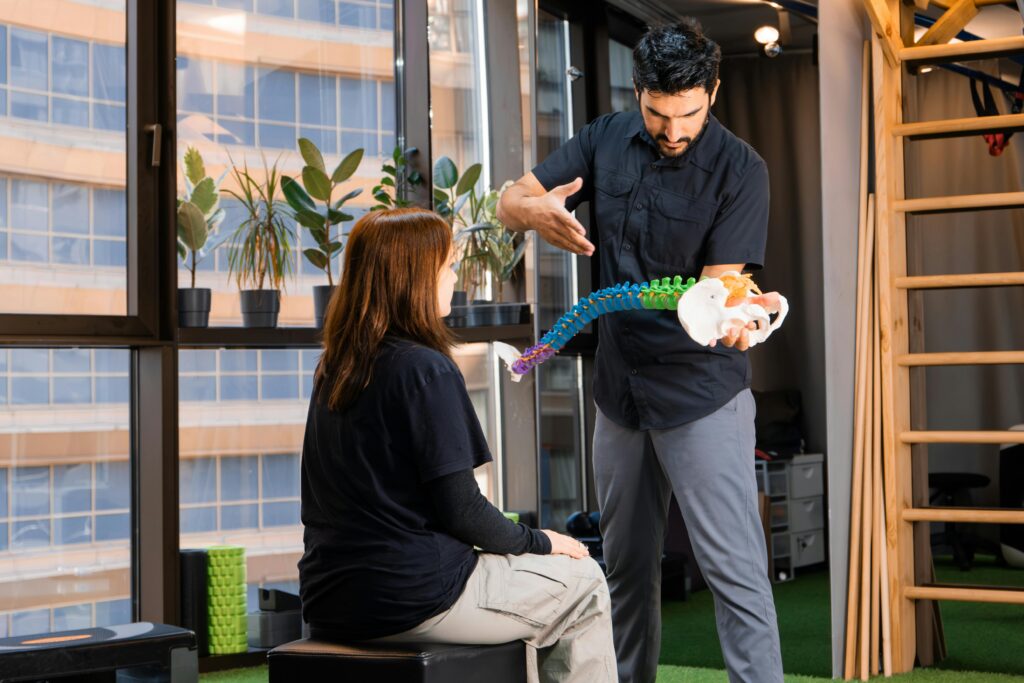
Biomechanical Analysis: How Exercise Physiologists in Columbus Are Rewriting the Rules of Movement
Your body has been sending you signals for years.
That nagging tightness in your left hip after a run. The way your right shoulder quietly protests after a long day at the desk. The knee that flares up during a hike even though you warmed up, stretched, and did everything “right.”
These aren’t random. They’re a language. And most fitness approaches — the generic programs, the one-size-fits-all boot camps, the YouTube routines — never bother to learn it.
Biomechanical analysis is the art and science of reading that language fluently.
Think of it like a master navigator who doesn’t just know the destination — they understand every current, wind pattern, and undercurrent working beneath the surface. That’s what a true movement assessment does. It doesn’t just see what your body looks like at rest. It maps where force travels, where it gets lost, where compensations have quietly built up like barnacles on a hull — slowing you down, wearing you out, and setting you up for injuries you never saw coming.
At Columbus Fitness Consultants, biomechanical analysis isn’t a buzzword on a brochure. It’s the foundation of everything.
—
What Personal Trainers in Columbus Get Wrong About Movement
Most personal trainers look at what you *can* do. Biomechanical analysis asks *why* you move the way you do.
There’s a significant difference.
If you come in with a sore lower back, a conventional approach might give you core exercises and call it a day. But what if your lower back is sore because your glutes have gone offline? What if your thoracic spine lacks the rotation it needs, so your lumbar spine is picking up the slack — doing a job it was never designed to do?
The body is brilliant at compensation. Too brilliant, sometimes. It will sacrifice long-term integrity for short-term function every single time. Your body wants to keep moving. It just doesn’t always move wisely.
This is where exercise physiology and biomechanical engineering expertise change everything. The staff at Columbus Fitness Consultants aren’t just personal trainers — they hold four-year degrees in Exercise Physiology and Kinesiology, and they collaborate with physical therapists and licensed athletic trainers on every complex case. When you walk through the door, you’re not being evaluated by someone who passed a weekend certification. You’re being assessed by professionals who understand the human body at a systems level.
That depth of knowledge is rare. In Columbus, it’s what sets this team apart.
—
How Corrective Exercise Specialists in Columbus, Ohio Approach Assessment
The biomechanical assessment process begins before a single weight is lifted or a single step is run.
It starts with observation.
How do you stand? Where does your weight naturally shift? When you perform a simple squat, does your left knee dive inward? Does your right heel lift early? Does your torso lean excessively to one side, quietly hinting that one hip is compensating for the other?
These are not just aesthetic quirks. They are structural stories.
The corrective exercise specialists at Columbus Fitness Consultants use a layered assessment approach. They look at static posture, dynamic movement patterns, joint range of motion, and muscle activation sequencing. Think of it like a detective working a case with multiple clues — no single observation tells the full story, but together, the picture becomes undeniably clear.
This matters deeply for adults navigating the complexity of aging — the 50+ community in Columbus, Dublin, and Upper Arlington who want to stay active, independent, and strong for decades ahead. It matters equally for young professionals in Westerville and Hilliard who train hard, sit at a desk for eight hours, and wonder why their bodies feel older than they should. And it matters enormously for the junior high, high school, and college athletes whose families want to protect their performance and prevent injuries before they derail a season — or a career.
—
Muscle Activation Techniques in Columbus: When Muscles Go Silent
One of the most powerful tools in the biomechanical analysis toolkit is understanding which muscles are *not* doing their job.
Muscle Activation Techniques (MAT) is a specialized system that identifies and addresses muscular inhibition — essentially, muscles that have gone quiet. When a muscle stops communicating properly with the nervous system, neighboring muscles step in. Over time, those overworked muscles become tight, fatigued, and injury-prone.
It’s like a rowing team where three people have stopped rowing. The rest of the crew doesn’t stop — they compensate. They row harder. And eventually, they burn out.
MAT works by assessing the specific muscles that have lost their connection to the nervous system and systematically re-establishing that communication. The results can be striking — chronic tightness that has persisted for years sometimes releases in a single session, not because the tight muscle was stretched, but because the weak, silent muscle finally came back online.
For personal training with injuries, this approach is transformative. It gets to the root of why the injury keeps recurring rather than patching the symptom over and over again.
—
Why Biomedical Fitness in Columbus Demands a Systems Approach
A single movement doesn’t happen in isolation.
When you take a step, your foot, ankle, knee, hip, pelvis, spine, and shoulder are all involved — each joint communicating with the next through a chain of coordinated muscular and neurological events. Disrupt one link and the ripple effects travel up and down that chain faster than you can feel them.
This is why biomedical fitness is categorically different from conventional fitness.
Biomedical fitness treats the body as an integrated system. It asks not just “can you lift this weight?” but “what are the mechanical consequences of *how* you’re lifting it?” Not just “can you run?” but “what is happening at your hip, knee, and ankle during every footstrike — and what does that mean for your joints ten years from now?”
The team at Columbus Fitness Consultants are pioneers of this philosophy in Central Ohio. Their advanced rehabilitation and corrective exercise services bring together the precision of physical therapy with the progressive science of exercise physiology — creating a continuum of care that most facilities simply don’t offer.
This is particularly valuable for post-physical therapy training in Columbus. The gap between “cleared by your PT” and “truly ready to train” is wider than most people realize. Biomechanical analysis fills that gap with clarity and confidence.
—
Orthopedic Fitness Assessment in the Columbus Metro Area
For people with complex orthopedic histories — hip replacements, ACL reconstructions, spinal surgeries, rotator cuff repairs — returning to fitness isn’t just about rebuilding strength. It’s about relearning movement.
Surgery changes the body’s architecture. Scar tissue forms. Compensatory patterns become deeply ingrained during the recovery period. The nervous system redraws its maps. And if those altered patterns go unaddressed, they become the foundation of the next injury.
Orthopedic fitness at Columbus Fitness Consultants bridges the clinical and the athletic. The team understands what happens in an operating room and what the body needs afterward — not just to function, but to thrive.
Residents throughout the Columbus metro area — from Worthington to Dublin to Upper Arlington — who are navigating post-surgical recovery have found in this team something rare: professionals fluent in both the language of medicine and the language of movement.
—
What Exercise Physiologists Add to Biomechanical Analysis
Biomechanical analysis becomes exponentially more powerful when it’s paired with physiological data.
How does your cardiovascular system respond to the demands you’re placing on your musculoskeletal system? Where does your energy production break down — and what does that mean for how hard you can actually train before you start compensating?
This is where the deeper diagnostic tools available at Columbus Fitness Consultants become game-changing.
VO2 max testing measures your body’s peak oxygen uptake — a gold-standard indicator of cardiovascular fitness and long-term health that research increasingly links to longevity. Lactate testing reveals your precise metabolic thresholds, allowing exercise physiologists to prescribe training zones with surgical accuracy rather than guesswork. And DEXA scans provide a detailed map of body composition — muscle, fat, and bone density — that informs both movement assessment and programming decisions.
When you layer these physiological insights onto a biomechanical analysis, you stop training by feel and start training by data. You understand not just how your body moves, but how it fuels movement — and where the leverage points are for meaningful, lasting change.
For athletes in Columbus and the surrounding area, this integration is the difference between training harder and training smarter. For adults over 50, it’s the difference between hoping to stay healthy and understanding exactly what it takes to make that a reality.
—
Personal Training with Physical Therapists in Dublin and Westerville
The collaboration model at Columbus Fitness Consultants is something you won’t find at most gyms.
Having physical therapists and licensed athletic trainers as part of the fitness team — not as separate providers you’re referred to across town — means that the line between rehabilitation and performance training is seamlessly managed. You don’t fall through the cracks. You don’t get conflicting advice. You get a cohesive plan built by people who are all speaking the same language about your body.
For families in Dublin and Westerville with high school or college athletes, this is invaluable. A biomechanical analysis early in a young athlete’s career can identify compensatory patterns before they become chronic injuries — the kind that shut down seasons and dim futures. An exercise physiologist working alongside an athletic trainer can build a program that enhances performance while protecting the structural integrity of a developing body.
This is the preventive power of biomechanical analysis. It doesn’t wait for something to break.
—
The Vitality Consulting Program: Biomechanical Analysis for the Long Game
Not everyone who comes to Columbus Fitness Consultants is in pain or recovering from injury. Many are healthy, active, and simply want to make sure they stay that way.
For that person — the one playing the long game — the Vitality Consulting Program offers a comprehensive, science-driven approach to healthspan optimization.
It integrates biomechanical analysis, physiological testing, body composition assessment, and personalized programming into a single, coherent strategy. It’s not reactive. It’s proactive. It asks: What does your body need to perform at its best — not just this year, but in five years, ten years, thirty years?
Healthspan isn’t just about living longer. It’s about living fully. The adults across Central Ohio who are choosing this path are discovering that the body you want in your 70s is built in your 50s — and the habits and patterns that make that possible start with truly understanding how your body moves right now.
—
Finding the Best Personal Trainers in Columbus, Ohio for Biomechanical Work
Not all personal training is created equal. And when movement quality, injury prevention, and long-term health are the goals, the credentials and methodology of the team you work with matter enormously.
The best personal trainers in Columbus for this kind of work are the ones who think like clinicians and coach like athletes. They understand anatomy not as a memorized chart but as a living, dynamic system with its own logic and language. They ask questions before they prescribe. They observe before they program.
They know that exercise is medicine — and that like all medicine, it must be precisely dosed.
Our approach at Columbus Fitness Consultants was built on exactly this philosophy. Every program begins with understanding. Every exercise is chosen with intention. And every client — whether they’re a 60-year-old Worthington resident hoping to hike confidently through retirement or a 22-year-old Hilliard athlete chasing a college career — receives a plan built around the unique mechanics of their own body.
—
Your Body Has a Blueprint. It’s Time to Read It.
Biomechanical analysis isn’t a luxury for elite athletes. It’s not a clinical tool reserved for people in pain. It’s a map — available to anyone willing to look honestly at how they move and what their body is trying to tell them.
The people who stay active, injury-free, and genuinely strong into their 60s, 70s, and beyond are not the ones who trained the hardest. They’re the ones who trained the most intelligently. They understood their compensations before they became injuries. They addressed the silent muscles before the loud ones screamed for attention. They played the long game with the precision it deserves.
Your body has been speaking. Columbus Fitness Consultants knows how to listen.
Reach out today to schedule your biomechanical analysis and discover what’s possible when fitness is built on a foundation of true understanding.